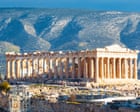
A new mathematical study has questioned a long-held theory about the Parthenon’s design, suggesting its famous curves may not have been intended to counteract optical illusions as previously believed. For centuries, the temple’s architects have been credited with intentionally shaping its structure to compensate for visual distortions that could have disrupted its symmetry. The research, however, proposes that this assumption—rooted in admiration for the temple’s precision—may be one of history’s most enduring misconceptions. The findings could reshape understanding of ancient Greek architectural techniques and the intentions behind one of the world’s most iconic buildings.
Study challenges belief that temple’s curves were designed to correct optical illusions that would have ruined its clean linesA mathematician has uncovered what may be one of the longest-running myths in history after studying optical illusions and the Parthenon, the famed Greek temple that overlooks Athens.Scholars have marvelled at the building on the Acropolis hill for more than 2,000 years and heaped praise on its architects for their clever use of geometry. Its subtle curves are said to correct optical illusions that would have otherwise ruined the Parthenon’s clean lines. Continue reading...


